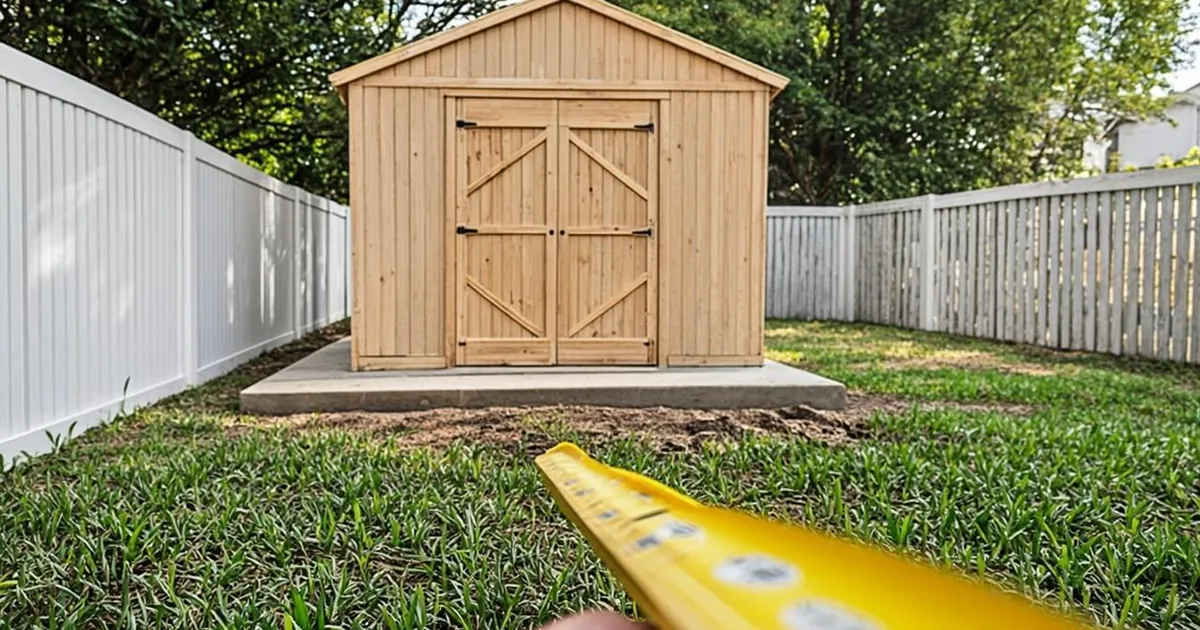
You've picked out the shed, found a flat spot in the backyard, and then a neighbor drops the question that stops every weekend project: "You're pulling a permit for that, right?" It sounds like small talk. It isn't. The answer decides whether you build this weekend or wait two weeks for a city sign-off.
So, do you need a permit to build a shed? In most cases, no — as long as the shed is small, single-story, and stays clear of property lines. The model building code used across the U.S. waives the building permit for one-story storage sheds up to 200 square feet, and many cities still work with an older, stricter limit of 120 square feet. The exemption shrinks quickly, though. Wire the shed for electricity, push it too close to your lot line, or live in a city with its own rules, and the permit office is back in the picture.
This guide breaks down the exact size thresholds, the four situations where even a small shed needs approval, the setback rules that decide where your shed can sit, what permits cost, and how the process works when you do need one. Every rule cited here comes from model building codes or official city and county sources.
Updated: August 31, 2026
Table of Contents
- 1When You Don't Need a Shed Permit
- 2The 200 vs. 120 Square Foot Rule
- 3When a Small Shed Still Needs Permission
- 4Electricity or Plumbing Changes Everything
- 5Zoning Permits Are Separate From Building Permits
- 6Height, Lot Coverage, and Special Areas
- 7HOA Approval Is a Different Gate
- 8How Close Can a Shed Be to the Property Line?
- 9What Happens If You Build a Shed Without a Permit?
- 10How Much Does a Shed Permit Cost?
- 11How to Get a Shed Permit When You Need One
- 12Shed Permit Rules From Real Jurisdictions
- 13Shed Permit FAQs
- 14How big can a shed be without a permit?
- 15Do I need a permit for a shed with electricity?
- 16Can I put a shed right next to my property line?
- 17What happens if you build a shed without a permit?
- 18How much does a shed permit cost?
- 19Do I need a permit to replace an existing shed?
When You Don't Need a Shed Permit
Building codes treat sheds as "one-story detached accessory structures" — the same family as playhouses and garden storage buildings. Meet the size limit your jurisdiction uses, and the building permit requirement disappears. That waiver comes with four standard conditions, and all of them have to hold.
- One story only — no loft, no second floor, no raised roof deck.
- Detached from the house — a shed attached by a wall or roof follows the same rules as a home addition.
- Storage and similar non-living use — nobody sleeps or cooks in it.
- Not a storm shelter — the model code specifically excludes storm shelters from this exemption, since they carry structural safety requirements.
If all four describe your project, size is the only number left to check — and that's where things get interesting.
The 200 vs. 120 Square Foot Rule
The International Residential Code (IRC) is the model code most states adopt, and its 2024 edition sets the exemption at 200 square feet of floor area for one-story detached accessory structures. That's a 10x20 shed — comfortably bigger than the 10x12 or 12x12 kits most homeowners buy. You can read the exemption in Section R105.2 of the 2024 IRC yourself.
Here's the catch that trips people up: states and cities adopt the IRC on their own schedules and rewrite it along the way. Many never moved to the higher limit. California's residential code still uses 120 square feet as its exemption ceiling, and the county layer can be stricter still — Los Angeles County exempts sheds up to 120 sq ft but caps their height at 12 feet. That's why a search engine gives you five different answers to the same question: the model code says 200, your local code may say 120, and your city's adopted version is the only one that counts.
A five-minute call to your building department resolves it. Ask one specific question: "What's the largest shed I can build without a building permit at my address?" The "at my address" part matters, because zoning overlays and flood zones can change the answer lot by lot.
📌 Quick facts:
- Model code limit (2024 IRC): 200 sq ft, one story, detached
- Common local limit: 120 sq ft — used in California, New York City, and many other jurisdictions
- Height caps are separate: 7 ft 6 in for backyard sheds in NYC, 12 ft in LA County
- Electrical, plumbing, and mechanical work always need their own permits — even for an exempt shed
When a Small Shed Still Needs Permission
Four situations pull a shed back into the permit system regardless of its footprint. Each one catches a different group of homeowners, and the fourth is the one almost nobody expects.
Electricity or Plumbing Changes Everything
The size exemption covers the building, not the systems inside it. Section R105.2 of the IRC says it directly: exempting the structure doesn't waive the separate plumbing, electrical, or mechanical permits those systems require. A shed running on a battery lantern needs nothing. A shed with wired circuits, a subpanel, or hardwired outlets is a different project in the permit office's eyes — the electrical work gets its own permit and inspection, even when the shed itself is exempt.
Running water is the same story. A sink or a drain line turns a storage shed into a plumbing project, and plumbing work without a permit is one of the fastest ways to fail a future home inspection.
Zoning Permits Are Separate From Building Permits
Here's the nuance most guides skip: "no building permit" doesn't always mean "no paperwork at all." Orange County, Florida spells it out — a shed up to 120 square feet skips the building permit but still needs a zoning permit so the county can verify placement against setback and land-use rules. Some Florida counties go even lighter: plastic or rubber storage sheds under about 68 square feet are exempt in Charlotte County, but even those must sit within zoning setbacks.
The pattern is consistent across the country. The building department may not care about your 10x12 shed. The zoning office always does. Expect a shorter, cheaper process — not zero process.
Height, Lot Coverage, and Special Areas
Size in square feet isn't the only number on the zoning sheet. Jurisdictions cap accessory structure height — 7 feet 6 inches for backyard sheds in New York City, 12 feet in LA County — and many limit how much of the lot all your buildings can cover combined. Cross any of those lines, and the review process returns.
Location on the lot matters too. In flood zones, coastal high-hazard areas, and historic districts, even a 100-square-foot shed can trigger review, anchoring requirements, or design approval. Hillsborough County, Florida, for example, publishes a full permit guide for accessory structures over 150 square feet precisely because Florida's wind and flood rules make even mid-size sheds a structural question. If your home sits in a special district, assume the exemption is thinner than the brochure says.
HOA Approval Is a Different Gate
A building permit and an HOA approval run on separate tracks, and passing one doesn't clear the other. Even a permit-exempt shed usually needs architectural review in a managed community — placement, exterior materials, colors, and sometimes height. The HOA can't overrule the building code, but the code's exemption doesn't overrule the HOA's contract either. Florida's 2026 House Bill 803 narrows how homeowners associations can hold up certain single-family projects, so the ground is shifting — HB 803 took effect July 1, 2026 — but the practical advice holds everywhere: get the HOA sign-off in writing before the truck delivers your kit.
How Close Can a Shed Be to the Property Line?
Setbacks are the quiet killer of shed projects. They're measured from your property line to the shed's wall, and even a permit-exempt shed has to respect them. The distances vary more than most homeowners expect, because each city writes its own zoning table.
New Orleans requires detached accessory structures to sit at least 3 feet from any lot line. Raleigh, North Carolina keeps small accessory structures — 150 square feet or less, up to 10 feet tall — at least 5 feet from side and rear property lines under its accessory structure rules. Other cities push the number to 10 feet. A handful allow building inside the rear setback with conditions — Walnut Creek, California permits it when the structure stays under 9 feet tall and a solid fence or wall screens it from neighboring view.
Three more placement checks before you stake out the footprint:
- Front setbacks — sheds belong behind the house line almost everywhere; front-yard placement is restricted or banned.
- Lot coverage — the combined footprint of house, shed, and decks often can't exceed a percentage of the lot.
- Easements — utility corridors on your plat map allow no permanent structures at all.
⚠️ Warning: a shed that's exempt from a building permit is not exempt from setbacks. A structure that crosses a lot line can be ordered moved or removed at your cost — and that order doesn't care that the shed came home on a trailer.
What Happens If You Build a Shed Without a Permit?
If your shed needed a permit and you skipped it, the consequences follow the same chain as any unpermitted work. A complaint or routine drive-by can trigger a stop-work notice. Fines stack daily in some jurisdictions and commonly exceed the permit fee many times over. Worst case, the city orders the shed removed entirely. The full sequence — enforcement, after-the-fact permits, and what it does to a sale — is covered in what happens if you build without a permit.
The resale angle deserves its own paragraph, because it's where small sheds do the most damage. Unpermitted structures surface during buyer inspections and appraisals, and they give buyers leverage: a price reduction, a repair credit, or a demand that you tear the shed down before closing. Legal-exempt sheds avoid this — but only if the size and placement genuinely match your local exemption. A shed that's three feet over the limit isn't a legal shed with missing paperwork; it's an unpermitted structure.
Compare the two paths honestly. The permit, when required, usually costs less than a decent dinner out. The unpermitted route risks fines, removal, and a stalling sale. There's no version of the math where skipping it wins.
How Much Does a Shed Permit Cost?
When a permit is required, shed permits sit at the cheap end of the building-permit world. Cities charge either a flat fee or a per-square-foot rate, and small projects rarely carry plan-review hours. Real examples from current fee schedules:
| Jurisdiction | How it charges | Current figure |
|---|---|---|
| Lubbock, TX | Per square foot under roof | $0.15/sq ft — a 200 sq ft shed runs about $30 |
| Cobb County, GA | Flat fee by project value | $80 minimum for residential projects up to $15,000 |
| Riverside County, CA | Plan-check deposit by building size | $1,628.78 deposit for accessory buildings up to 1,000 sq ft |
A realistic budget for a typical residential shed permit is $50 to $200 in most cities, with plan-check-heavy jurisdictions — especially in California — running higher. Riverside's figure is a deposit against actual review time, which is why big-county numbers look shocking next to Lubbock's thirty dollars. For context across every project type, see what building permits cost in your state.
💡 Tip: fee schedules change every fiscal year — Austin's FY 2025-26 schedule took effect October 1, 2025, and most cities follow a similar October or July cycle. Pull the current schedule, not a blog post, before you budget.
How to Get a Shed Permit When You Need One
The process for a small accessory structure is far lighter than what a deck or addition goes through. Five steps, start to finish:
- Confirm the rules for your address. Call or check the city's site for three numbers: the size exemption, the required setbacks, and whether a zoning permit applies even without a building permit.
- Sketch a site plan. One page: lot lines, the house, the proposed shed, and the distance from the shed to every property line. Graph paper is fine — most small-shed reviews don't demand stamped drawings.
- Submit the application with the fee. Many cities take small accessory structure applications online. Attach the site plan and the manufacturer's spec sheet if you bought a kit.
- Wait for review. Small-shed permits routinely clear in days, not months, though every office is different — how long it takes to get a building permit covers the full range and the factors that slow reviews down.
- Build to the approved plan and schedule inspections. High-wind areas often require an anchor or foundation inspection before use. Skipping the final inspection leaves the permit open, which surfaces at resale just like no permit at all.
💡 Tip: apply before you buy the shed kit. Setback rejections are the most common reason small-shed applications fail, and a rejected kit is a return-shipping headache.
Shed Permit Rules From Real Jurisdictions
These examples come straight from adopted codes and county guidance, and they show how differently the same question gets answered from one line to the next:
| Jurisdiction | Building permit exemption | Extra rules to know |
|---|---|---|
| 2024 IRC (model code) | ≤200 sq ft, one story, detached | Adopted locally with amendments |
| California (2022 CRC) | ≤120 sq ft | County height caps common — LA County: 12 ft |
| New York City | ≤120 sq ft | 7 ft 6 in height limit; over 121 sq ft needs plans and permits |
| Orange County, FL | ≤120 sq ft (no building permit) | Zoning permit still required |
| Hillsborough County, FL | Small sheds exempt | Full guide and permits for structures over 150 sq ft |
| Raleigh, NC | ≤150 sq ft and ≤10 ft tall | 5 ft minimum side and rear setbacks |
| New Orleans, LA | Varies by structure | 3 ft minimum from any lot line |
Treat the table as a starting point, never as permission. Codes get amended mid-year, and a single flood-zone or historic-district overlay can flip the answer for one lot inside an exempt city. The building department's word beats every table on the internet, including this one.
Shed Permit FAQs
How big can a shed be without a permit?
Under the 2024 model code, up to 200 square feet for a one-story detached shed used for storage. Many cities and states still enforce the older 120-square-foot limit — California and New York City among them. Height caps (often 12 feet or less) and local amendments apply on top of the size limit, so confirm your city's number before buying.
Do I need a permit for a shed with electricity?
Yes — in nearly every jurisdiction, the electrical work needs its own permit and inspection even when the shed itself is permit-exempt. The IRC's exemption section says directly that separate plumbing, electrical, and mechanical permits may still be required. Hardwired circuits and subpanels are never covered by a size exemption.
Can I put a shed right next to my property line?
Usually no. Typical setbacks run from 3 to 10 feet: New Orleans requires 3 feet from any lot line, Raleigh requires 5 feet for small accessory structures, and some cities allow rear-setback placement only with screening and height conditions. Your plat map also matters — easements allow no permanent structures at all.
What happens if you build a shed without a permit?
If the shed exceeded your local exemption, you're exposed to stop-work orders, fines that can stack daily, and in the worst case a removal order. Unpermitted structures also surface at resale and give buyers leverage over price or closing. If it already happened, an after-the-fact permit is usually available and costs more than applying first.
How much does a shed permit cost?
Most homeowners pay between $50 and $200. Fee structures vary: Lubbock, Texas charges $0.15 per square foot under roof, Cobb County, Georgia charges an $80 minimum for small residential projects, and some California counties collect plan-check deposits that run well over $1,000 for larger accessory buildings.
Do I need a permit to replace an existing shed?
Often no, if the replacement matches the old shed's size and footprint and the old shed was legal — like-for-like swaps on exempt structures rarely trigger a new permit. The exemptions vanish again if the new shed is bigger, wired, or moved closer to a lot line. Demolition of a large old shed can also require its own permit in some cities, so describe the full project when you call.
For most homeowners, this whole question ends with one phone call and either a free afternoon of building or a short permit application. Get the size limit and the setbacks for your address first, and the rest of the project stays a weekend job instead of a city file.